
Volkswagen e-Golf charging
The Volkswagen e-Golf is an electric hatchback. You fill it from a J1772 plug at home and from a CCS1 plug on a long drive, and its longest 2019 version is rated at 125 miles on a full battery. Every number below says which version of the car it belongs to, and the two sliders below turn a charge into a time and a price.
- Official range (EPA)
125 mi
2019 e-Golf
How far a full battery is rated to go on the US test.
- Battery size
32 kWh
Volkswagen e-Golf
The size of the tank. Bigger means more miles between stops.
- Fastest charge
40 kW
10–80% in 36 min
How wide the hose is at a fast charger.
- Plugs it uses
CCS1
J1772 at home and slow posts
The shape that has to fit the socket.
The range and battery cards name different versions on purpose. One is the longest 2019 row the EPA tested, the other is the catalogue's charging record — because the EPA lists a range per trim and the catalogue lists one battery per trim. Nothing below quietly mixes them.
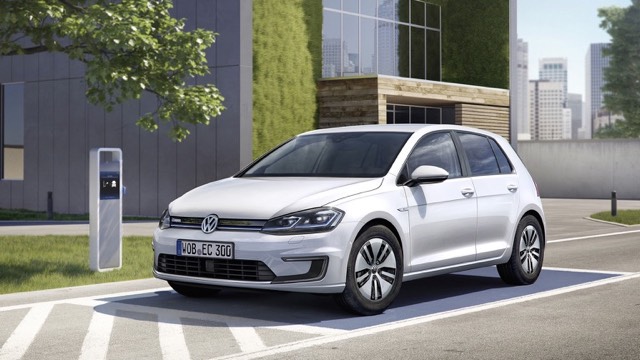
Hatchback · 2015–2019 · FWD
5 seats. 341 L of boot space. The photo is the model the catalogue lists, not a photo of a particular car for sale.
Start here
Six terms, in plain words
None of this needs a physics degree. Each term on a window sticker is one idea, and here they are in the order they turn up.
EPA range
A score from one official test.
The car runs on a rolling road until the battery is empty. Every car sits the same test, so the numbers compare fairly. It is a lab score, not a promise: a cold morning or a steady 75 mph uses more energy than the test did.
US trim
A version of the same car.
The body is the same; the wheels, motors or battery are not. A model is usually sold in several versions — Pure, Touring and Grand Touring on this car — and the EPA publishes a range for each one it tested, which is why one model carries several numbers for one year.
kWh
The size of the tank.
A kilowatt-hour is a unit of energy. A bigger battery holds more of it and goes further. This page shows the usable figure where the data says so, because a pack never gives up every last bit.
kW
How wide the hose is.
A kilowatt is a rate: energy per second. The same battery fills from a 1.4 kW wall socket or a 200 kW-plus fast charger. Wide hose, quicker fill — as long as the car and the station both agree.
AC and DC
Two kinds of electricity.
Home wiring supplies AC, and the car's own charger turns it into DC. A fast charger does that conversion in the station and feeds the battery directly, which is why it is many times quicker.
10–80%
The happy middle of a battery.
Packs accept full power in the middle and slow right down past 80% to protect the cells. That is why a road-trip stop is usually 10% to 80%: the last fifth can take as long as the first half.
Range
How far can it go on one charge?
The Volkswagen e-Golf is rated between 125 and 125 miles on a full battery, depending on the version; the highest belongs to the 2019 e-Golf.
The official figure comes from the EPA, the US agency that scores every car the same way: a full battery, a rolling road, and a number of miles at the end. It is the fair way to compare two cars, and still only a lab score — wind, hills, heaters and speed all take a bite out of it.
In 2019, the Volkswagen e-Golf was rated between 125 mi and 125 mi on a full battery, depending on the version.
e-Golf
125 mi
Trim names are the EPA's own labels, unedited, so “G Touring” is short for Grand Touring. Each row is a version the EPA tested; a version it did not test has no row. Figures are miles on the EPA's lab test, not a prediction of your commute.
Charging time
How long does a charge take?
A 10–80% fast stop takes about 36 minutes at a charger that can deliver the car's peak, and a full charge on a 7.2 kW home charger takes about 5 hours.
Three things decide it, and the slowest one wins: what the station can supply, what the car will accept, and how much the battery wants at that moment. Move the sliders and the answer changes with you.
Your charge
- Time at this charger
- 31 min
- Cost
- $6.72
- Energy
- 19.2 kWh
About a lunch stop. The session draws about 37 kW on average — a peak figure would be a promise the last part of the charge does not keep.
Times use the 32 kWh battery and 40 kW DC peak from the Volkswagen e-Golf record, and scale from its 36-minute 10–80% figure. Above 80% the estimate assumes a much slower rate; cold batteries and shared stations can be slower still.
The station
1.4–350 kW
A wall socket gives about 1.4 kW; a highway post 150–350 kW. The site's rating is a ceiling, not a promise.
The car
7.2 kW AC
The car takes no more than its own limit — 40 kW on DC, 7.2 kW on AC. A bigger charger cannot change that.
The battery
slower past 80%
Above 80% the pack asks for far less power to protect the cells, which is why trips stop at 80%.
The reasoning behind those numbers is on how long EV charging takes and Level 2 vs DC fast.
Plugs
Which plug fits this car?
Only two shapes matter: the one on the car and the one on the charger. The AC plug covers home charging and slow public posts; the DC plug covers fast stops on a trip.
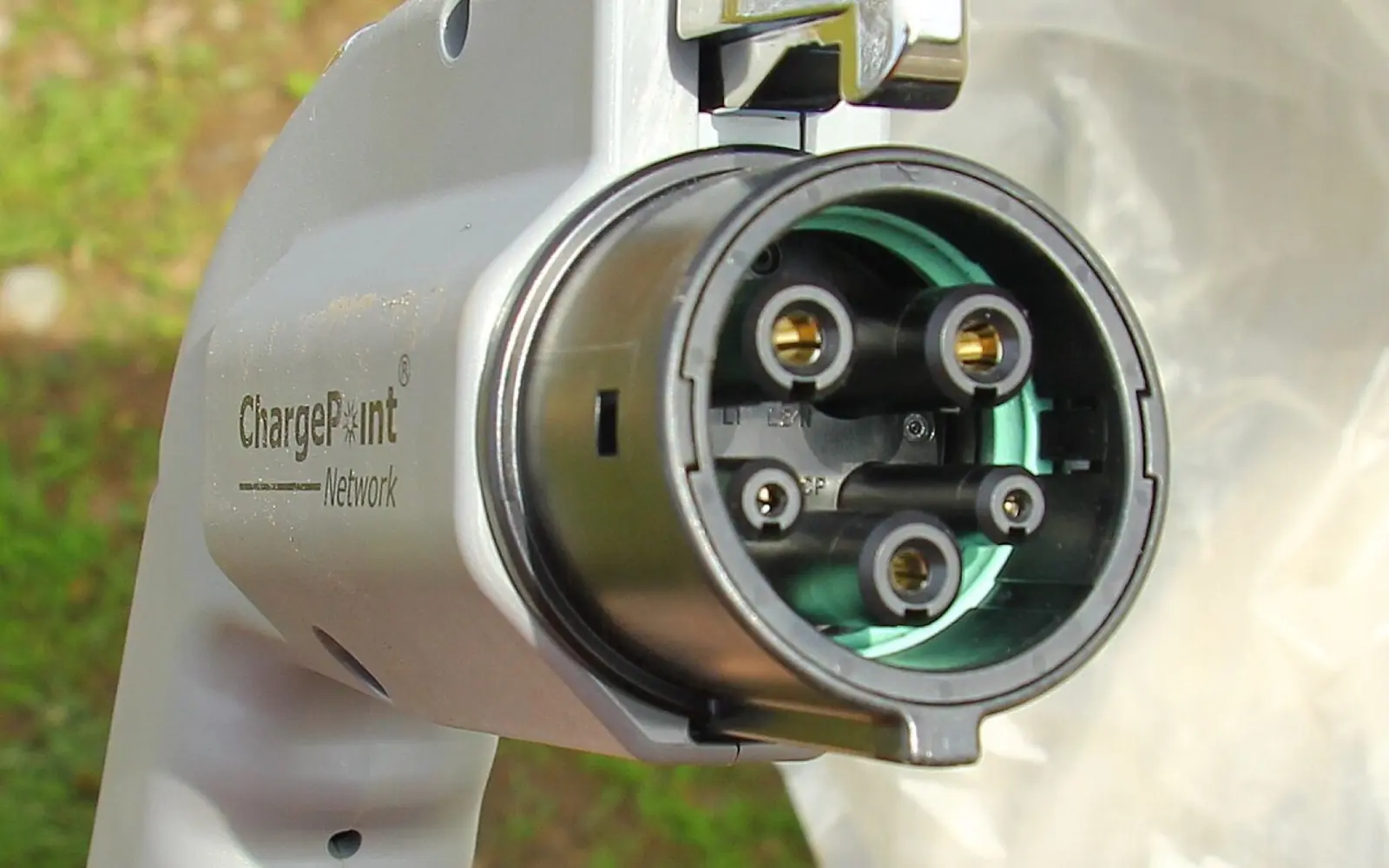
J1772
AC chargingSAE J1772 · Typically 3.3–19.2 kW
J1772 is the AC connector on almost every non-Tesla EV and plug-in hybrid sold in North America. At public stations it is usually a Level 2 charger.
Where you meet it: destination charging while parked.

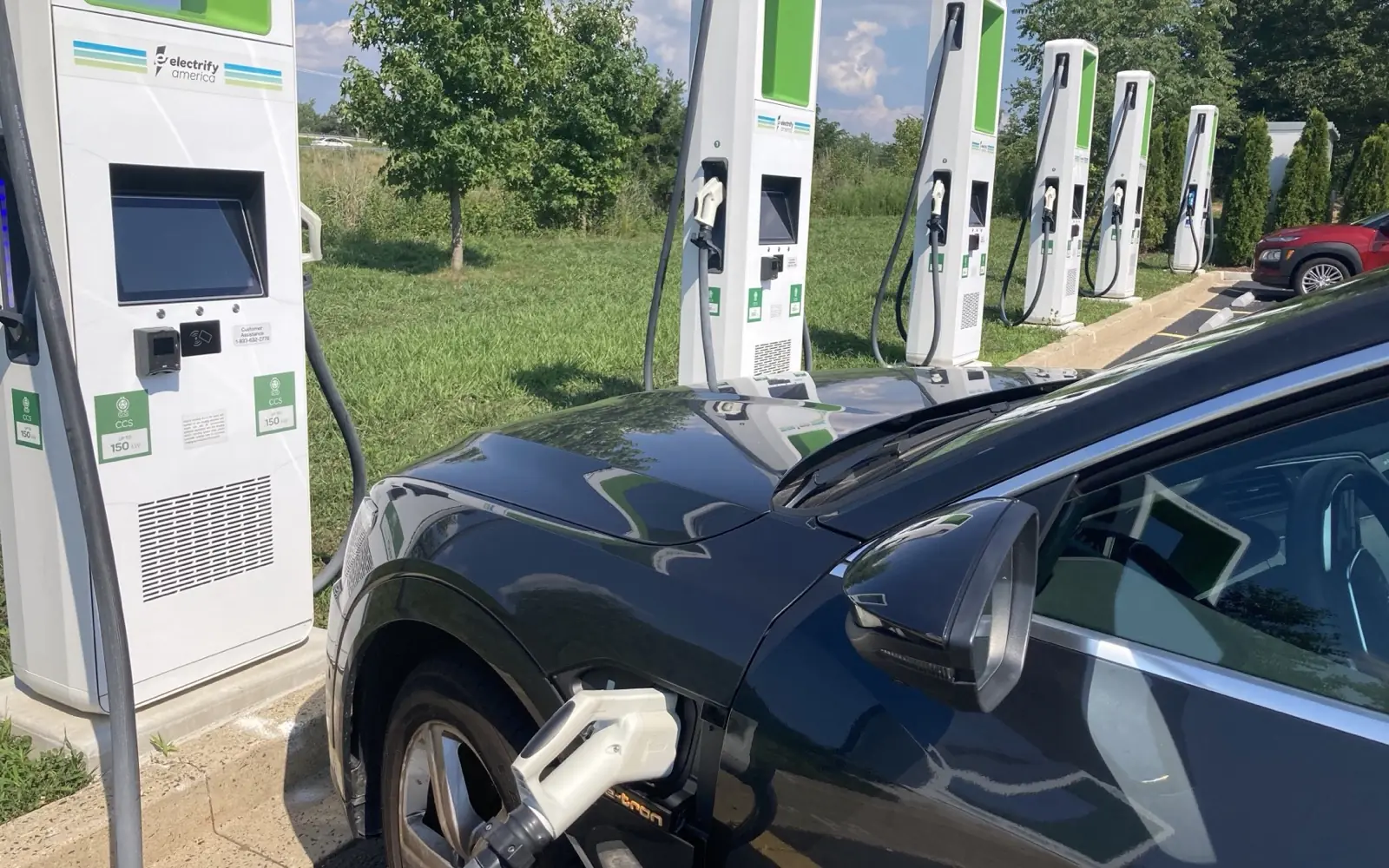
CCS1
DC chargingSAE J1772 CCS Combo 1 · Typically 50–350 kW
CCS1 is the DC fast connector on most non-Tesla EVs in North America. It keeps the J1772 shape for the AC pins and adds two DC pins underneath.
Where you meet it: fast charging on a longer trip.
Photo: Ken Fields · CC BY-SA 2.0

An adapter changes the shape of the plug, not what the car can accept or what the station can supply. It can bridge a standard; it cannot create power, access or a faster session.
This page lists the connectors the model reports. The directory records the connector a station reports, so a station that carries both a J1772 post and a CCS1 fast charger appears under each — and a car is not guaranteed a free one.
Cost
What does a charge cost?
Charging is priced by the kilowatt-hour, like electricity at home. The directory's median tariff is $0.35 per kWh — the middle of the prices networks actually list, not a quote for any one station.
At that median, filling the 32 kWh battery from empty at a DC post bills about $11.79. A 10–80% stop, the usual road-trip habit, moves about 70% of it and bills about $8.25. Type your own price into the calculator above to see your number instead.
Both figures are metered energy, not battery energy: a DC post puts roughly 95% of what it draws into the pack, so the bill sits slightly above battery × price. At home the conversion is closer to 90%. What is not in either figure: session fees, idle fees, parking and taxes. The state cost table has the local medians, and cost per mile turns this into a comparison with petrol.
Sources
US figures from the October 2026 data build. How these sources are chosen, and what a figure here never claims, is on the methodology page.
Full charge
$11.79
At $0.35 per kWh at a DC post, charging losses included.
10–80% stop
$8.25
About 70% of the battery, which is what most trips use.
Cheapest state median
$0.28
Iowa, per kWh — the lowest state median with a comparable sample.
Priced stations
3,805
Stations in the directory that publish a per-kWh tariff.
US trims
Every version, year by year
This is the list the chart above is drawn from. The names are the EPA's own labels, kept exactly as published — spelling, abbreviations and all — because rewriting a source label is how a table stops matching its source.
Show every EPA row (5)Year · trim · rangeTap to close
| Year | Trim | EPA range |
|---|---|---|
| 2019 | e-Golf | 125 mi |
| 2018 | e-Golf | 125 mi |
| 2017 | e-Golf | 125 mi |
| 2016 | e-Golf | 83 mi |
| 2015 | e-Golf | 83 mi |
EPA figures are the US label; they are not converted from WLTP. A trim the EPA does not list has no row, and an all-wheel-drive version of a rear-drive model appears as its own row because the EPA tested it separately.
Catalogue detail
Specifications
From the European catalogue trim Volkswagen e-Golf (2017). US trims, EPA range and connectors are above; equipment and dimensions can differ by market.
Performance
| Power | 100 kW (134 hp) |
|---|---|
| Torque | 290 Nm (214 lb-ft) |
| 0–100 km/h | 9.6 s |
| Top speed | 150 km/h (93 mph) |
| Drivetrain | FWD |
| Platform | VAG MQB |
Battery, range and V2X
| Usable battery | 32 kWh |
|---|---|
| Nominal battery | 35.8 kWh |
| Chemistry | Lithium-ion |
| Nominal voltage | 325 V |
| Cell count | 264 cells |
| Pack configuration | 88s3p |
| WLTP range (EU) | 190 km (118 mi) |
| Efficiency (WLTP) | 12.9 kWh/100 km |
| Cold highway (catalogue estimate) | 124 km (77 mi) |
| Mild urban (catalogue estimate) | 218 km (135 mi) |
| V2H | Not supported |
| V2G | Not supported |
WLTP and catalogue estimates describe the European trim; EPA range is above. V2X rows are the maker's catalogue equipment.
Dimensions and practicality
| Length | 4,270 mm (168.1 in) |
|---|---|
| Height | 1,450 mm (57.1 in) |
| Wheelbase | 2,631 mm (103.6 in) |
| Curb weight | 1,615 kg (3,560 lb) |
| GVWR | 2,020 kg (4,453 lb) |
| Payload | 480 kg (1,058 lb) |
| Turning circle | 10.9 m (35.8 ft) |
| Boot | 341 L (12 cu ft) |
| Max cargo | 1,231 L (43.5 cu ft) |
| Towing (unbraked) | 0 kg (0 lb) |
| Seats | 5 |
| Segment | C - Medium |
| ISOFIX | Yes, 2 seats |
| Roof rails | No |
| Heat pump | Standard Equipment |
Questions
Answers, briefly
Short answers first, the reasoning below each. Every figure here comes from the same data as the rest of the page.
Still unsure about a term? The charging glossary covers the rest of them.
What connector does the Volkswagen e-Golf use?
It lists J1772 for AC charging and CCS1 for DC fast charging. J1772 is what a home charger and a slow public post use; CCS1 is the fast plug for a longer trip. An adapter may bridge another standard, but support varies by vehicle and station.
How long does it take to charge a Volkswagen e-Golf?
The catalogue's 32 kWh usable battery and 40 kW DC peak give a 10–80% session of about 36 minutes at a station that can deliver the power. AC charging peaks at 7.2 kW, which suits overnight charging rather than a trip stop.
What is the EPA range of the Volkswagen e-Golf?
The 2019 Volkswagen e-Golf is rated between 125 and 125 miles, depending on the trim. The highest figure belongs to the e-Golf; every model year the EPA tested is listed on the page, and each row is a different version of the same car.
What does "US trim" mean on this page?
A trim is a version of the same car: same body, different wheels, motors or battery. The EPA tests each version separately, so one model can carry several range figures for the same year. Bigger wheels are the usual reason two rows differ, because they add drag and rolling resistance.
How much does it cost to charge a Volkswagen e-Golf?
At the directory's median of $0.35 per kWh, filling the 32 kWh battery from empty at a DC post bills about $11.79, and a 10–80% session about $8.25. Both are metered energy, so the charging loss is inside them. The median is the middle of the per-kWh tariffs networks list; session fees, idle fees and parking are excluded, and a home tariff is often cheaper.
Can a Volkswagen e-Golf use a Tesla Supercharger?
The Volkswagen e-Golf's fast-charge plug is CCS1. Some Tesla sites in this directory report a CCS1 plug; whether a particular site accepts an adapter is not recorded, so filter the map for CCS1 before you rely on one.
Related models
All electric vehicles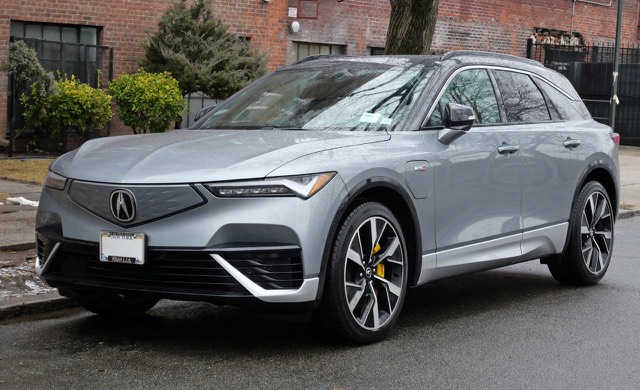 2026
Acura ZDX
SUV · 2024–2026
From $64,500 to $73,500
- EPA range
- 327 mi
- Battery
- 102 kWh
- DC peak
- 190 kW
 2027
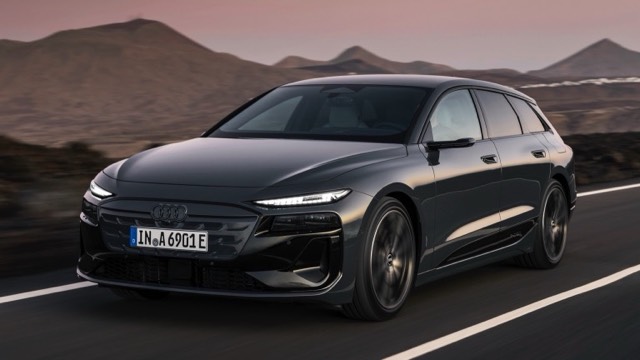
Audi A6 e-tron
Wagon · 2027
- EPA range
- 395 mi
- Battery
- 75.8 kWh
- DC peak
- 225 kW
 2023
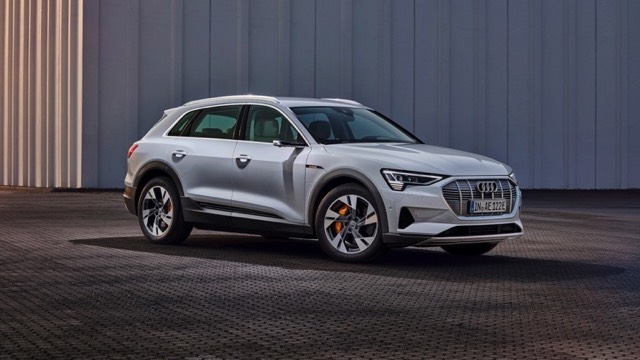
Audi e-tron
SUV · 2019–2023
- EPA range
- 226 mi
- Battery
- 64.7 kWh
- DC peak
- 120 kW