A US EV has one or two inlets, and the two are answered by different plugs: the AC inlet you use every night, and the DC inlet you use on a trip. The finder below reads both from the directory’s vehicle records.
Plug finder · 108 models
Find your car’s connectors
Two letters is enough to search. The answer is the inlet, not the badge — a model year can change it.
Start with one of these
The four connectors, and how much of each exists
Every station count on this page comes from the same build-time copy as the directory, so a number here and a number on a connector hub are the same count.
| Plug | Carries | Stations | 50 kW or more | Models here | What it fits |
|---|---|---|---|---|---|
| J1772 | AC | 5,294 | — | 102 | AC charging on almost every non-Tesla car |
| CCS1 | DC | 930 | 740 | 96 | Fast charging on most non-Tesla EVs since 2018 |
| NACS | AC / DC | 517 | 117 | 6 | Teslas and a few newer models |
| CHAdeMO | DC | 364 | 331 | 3 | Older Leafs and Japanese EVs |
Counts are records in this directory, not market totals: a car can list two connectors and a station can carry two. J1772 never delivers DC — the 193 stations that list it and report 50 kW or more hand that power out through a CCS1 or NACS connector on the same post.
Why almost every car has two connectors
A CCS1 port is a J1772 port with two DC pins bolted underneath it. That is not a naming convention: it is the same moulding, which is why all 96 models here that list a CCS1 fast inlet also list a J1772 AC inlet. The car has one port with two ways in — the round top for AC, the chin for DC — and the station decides which it hands you.
NACS does the same job with one set of pins: the car’s port takes AC and DC through the same oval, so there is nothing to separate. CHAdeMO went the other way and kept a second, physically separate DC port beside the J1772 AC one, which is why a Leaf has two flaps on its nose.
The directory also holds 3 records with no DC inlet at all — Ford Focus Electric, Mercedes-Benz B 250e, smart fortwo EQ — and no adapter adds one. If a car you own is on that list and you know it has a fast inlet, the record is the thing that is wrong, not the car.
The NACS switch is why the model year matters more than the badge
The directory lists a NACS inlet on 6 of its 108 models, and that number is too small to be the real picture. The connector in each record comes from the model’s older trim in a European catalogue, where the car was sold with CCS2 or a Type 2 port; the mapping to US plugs lands on CCS1 and J1772, which was right when those trims were built and is not right for a 2025 car that switched.
So the directory flags it instead of guessing: 84 of 108 records carry a note that the listed port may be out of date for a newer model year of that car. The finder above shows that note with the car, because a confident wrong answer is worse than a flagged one. When it appears, the inlet on the car — or the window sticker, or the VIN at a dealer — is the only source that settles it.
The plug also does not tell you the speed. 400 of the 517 NACS stations here report less than 50 kW, and most of them are AC destination posts wearing the same connector as a Supercharger. The Tesla guide covers what that means for a session.
Adapters: what bridges what
| Your inlet | The post | What you need | Then |
|---|---|---|---|
| NACS | J1772 | NACS-to-J1772 adapter | AC speed only, whatever the post's rating |
| NACS | CCS1 | NACS-to-CCS1 adapter, or a Magic Dock | Where the site is open to your car |
| J1772 + CCS1 | NACS fast | CCS1-to-NACS adapter | Where the Supercharger site is open to non-Tesla cars |
| J1772 + CCS1 | NACS slow | NACS-to-J1772 adapter | AC speed only — a destination post is not a fast charger |
| J1772 + CHAdeMO | CCS1 or NACS | Nothing in common use | The car stays on CHAdeMO for DC charging |
An adapter is car-side and never raises the rate: the session runs at the lower of the two limits. Fit is a physical question; access is a separate one, and a Supercharger can refuse a car with the right plug.
The one thing to check before buying an adapter
The four shapes are easy to tell apart once you have seen them, and almost impossible to describe over the phone to a driver at a broken post. Four photos, four answers, one tell each.
Game · four photos · name the plug
Which plug is this?
1 / 4 · 0 right
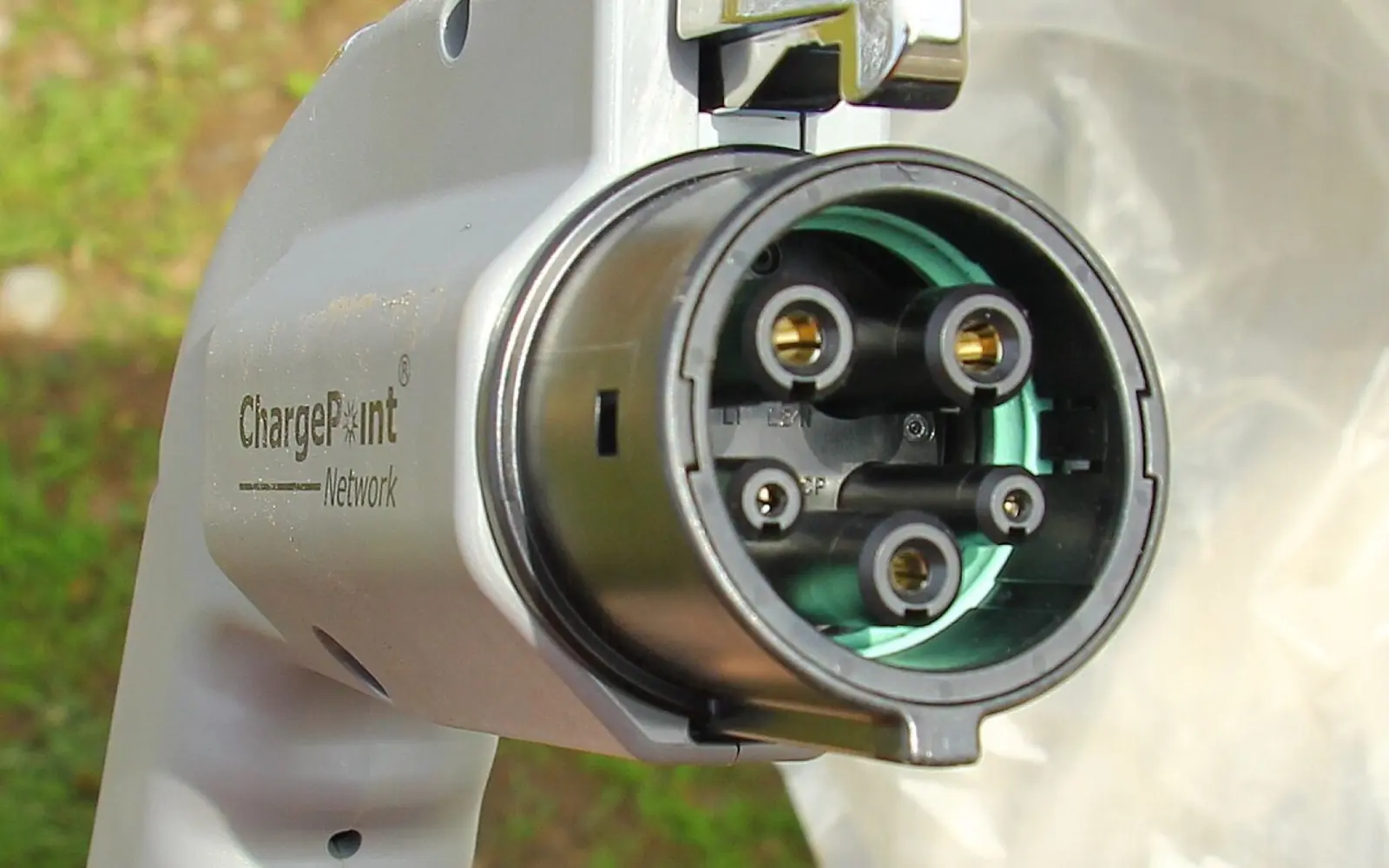
Name the plug in the photo. The answer is the standard, not the network.
Count the pins if you can see the face. J1772 and CCS1 share the round top, and that is the round most people lose.
Check it in 30 seconds
- Look at the shape: a circle is J1772, a circle with two pins below it is CCS1, a small oval is NACS, and a body the size of a fist with two large pins is CHAdeMO.
- Open the owner's manual to the charging section and read the two standards it names, not the marketing name. A CCS1 car is usually described as having a CCS1 fast inlet and a J1772 AC inlet.
- For a car you are buying, ask for a photo of the inlet or the VIN. A 2025 model can have a different port from the 2023 of the same name, which is the whole NACS problem in one sentence.
- For a rental, check the listing's connector field before planning a route. It records what the station reports, not what an adapter might make possible.
Browse models by connector
The vehicle index lists the connectors on every model, and each connector hub lists the stations that take it.